

All you want is a good night’s sleep but you shut your eyes and thoughts are racing around in your head and you cannot seem to calm your brain enough to fall asleep. We’ve all been there, but when it starts happening on a daily basis, it can be really tricky to get the quality of sleep we need to function to our full potential during the day. It’s also so frustrating taking hours to fall asleep just because our brains won’t switch off. So, I’ve done my research and I’ve considered what things have helped me in the past, and here is a page that goes over all the little things you can do to reduce overthinking before sleep.
1. Create a wind-down buffer before bed
Overthinking thrives when you go straight from a busy day into trying to sleep. Give your mind a transition period—20 to 60 minutes where the goal is simply to slow down.
This could look like:
- dimming the lights
- making tea (I drink this sleepytime tea)
- reading something light
- stretching
- listening to calm music or a podcast
Think of it as gently telling your brain, “Hey… it’s time to power down now.”
2. Do a ‘brain dump’
One of the biggest culprits of nighttime overthinking is the fear of forgetting something important. Before bed, grab a notebook or your phone’s notes app and write down anything lingering in your mind—tasks, worries, reminders, thoughts.
It doesn’t have to be organized. Just get it out of your head and onto a page.
Your mind relaxes when it knows it won’t lose track of things overnight.
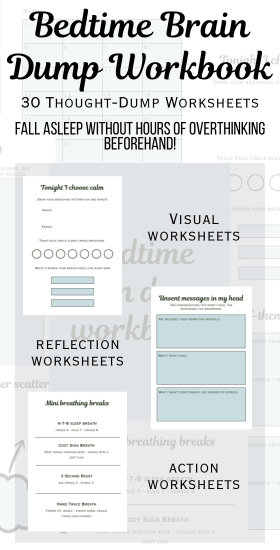
Check out my instant download digital product that you could print or fill in on a touchscreen with a stylus:
Bedtime Brain Dump Workbook for Overthinkers
3. Try a grounding technique
Grounding pulls you out of your thoughts and back into your body.
A simple, effective one is the 4-7-8 breathing method:
- Inhale for 4 seconds
- Hold for 7
- Exhale for 8
Repeat a few times. It slows your heart rate and physiologically signals your body that it’s safe to rest.
Another option: gently tense and release different muscle groups starting from your toes upward. It’s surprisingly soothing.
4. Limit overstimulation in the evening
If your brain is overstimulated, it won’t just turn off because you climbed into bed.
That means being mindful of things like:
- heavy social media scrolling
- intense conversations
- stressful news
- work emails
- binge-watching shows that hype you up instead of calm you down
Your brain needs low-intensity inputs at night, not a cliffhanger ending.
5. Set a worry cut-off time
This sounds strange, but it works: choose a time before bed when you’re allowed to think through problems—say, 6 p.m. or after dinner. Let your brain know:
“This is when we deal with stuff. Bedtime is for resting.”
It gives your mind a clearer boundary so it’s not trying to process everything at midnight.
6. Build a consistent bedtime routine
Your brain loves patterns. When you do the same things every night, in the same order, your mind begins to associate those actions with shutting down. Even a simple sequence like:
- shower
- skincare
- herbal tea
- ten minutes of reading
can train your brain to wind down automatically. Using a lavender pillow spray could help your brain sense a smell that means it’s time for sleep.
7. Keep your bedroom a calm, low-pressure space
If your room feels chaotic, it becomes harder to sleep. A few small changes can help:
- keep lighting warm and soft (fairylights are always a great cozy option!)
- reduce clutter where possible
- make your bedding cozy
- keep the room cool
- avoid working in bed (your brain then associates it only with rest)
Your environment matters more than you think.
Similar Articles:
Healthy Sleep During the Winter: How to Rest Better When the Nights Grow Long
How to Stop Overthinking Before Going to Sleep
Unload Your Thoughts and Drift to Sleep with the Bedtime Brain Dump Workbook